Since I started this blog over a decade ago, some of you have signed up for updates by email or through the WordPress subscribe button. I would so appreciate it if you would shift over to subscribing to my brand new mailing list.
I have Two Freebie Options for you, when you sign up.
One related to POTTER KNOWS BEST, the other related to training videos on writing. Choose the one below that interests you most when you sign up:
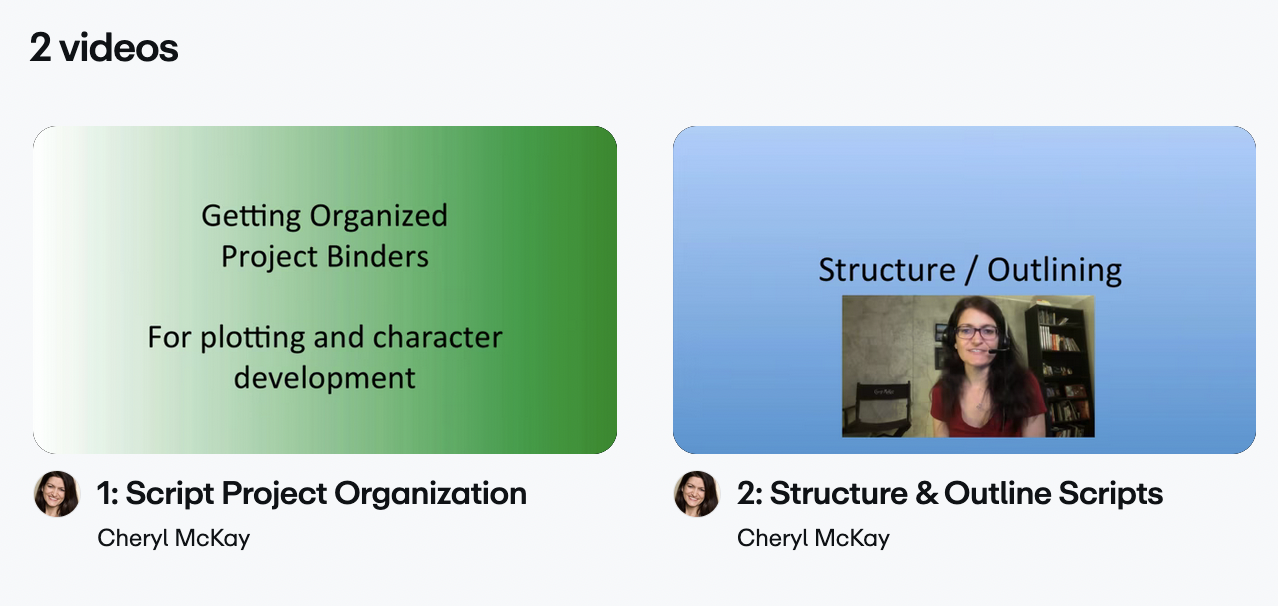
To Sign Up for 2 Free Writing Training Videos on Plotting and Organizing Script Projects, use this link or click on the graphic below:
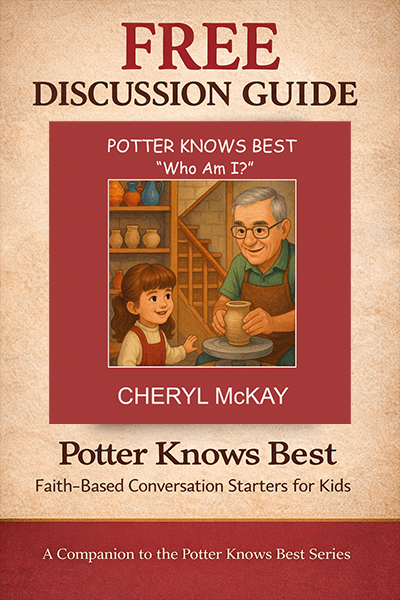
For a FREE Discussion Guide and FREE Printable Coloring Pages for Kids for the POTTER KNOWS BEST book series, please click here or click on the graphic below.
I will also send periodic updates about my books, films, TV series, and writing tips.
For those of you with an email like gmail, your freebie Welcome email with links will likely land in your Promotions folder. Please drag this over to your Inbox after arrival if you want to be sure my future emails go to your Inbox as well.
You can unsubscribe anytime, if it’s not for you. Most of the time I enjoy writing scripts and books, far and above newsletters. So I won’t be one of those every day newsletter senders.
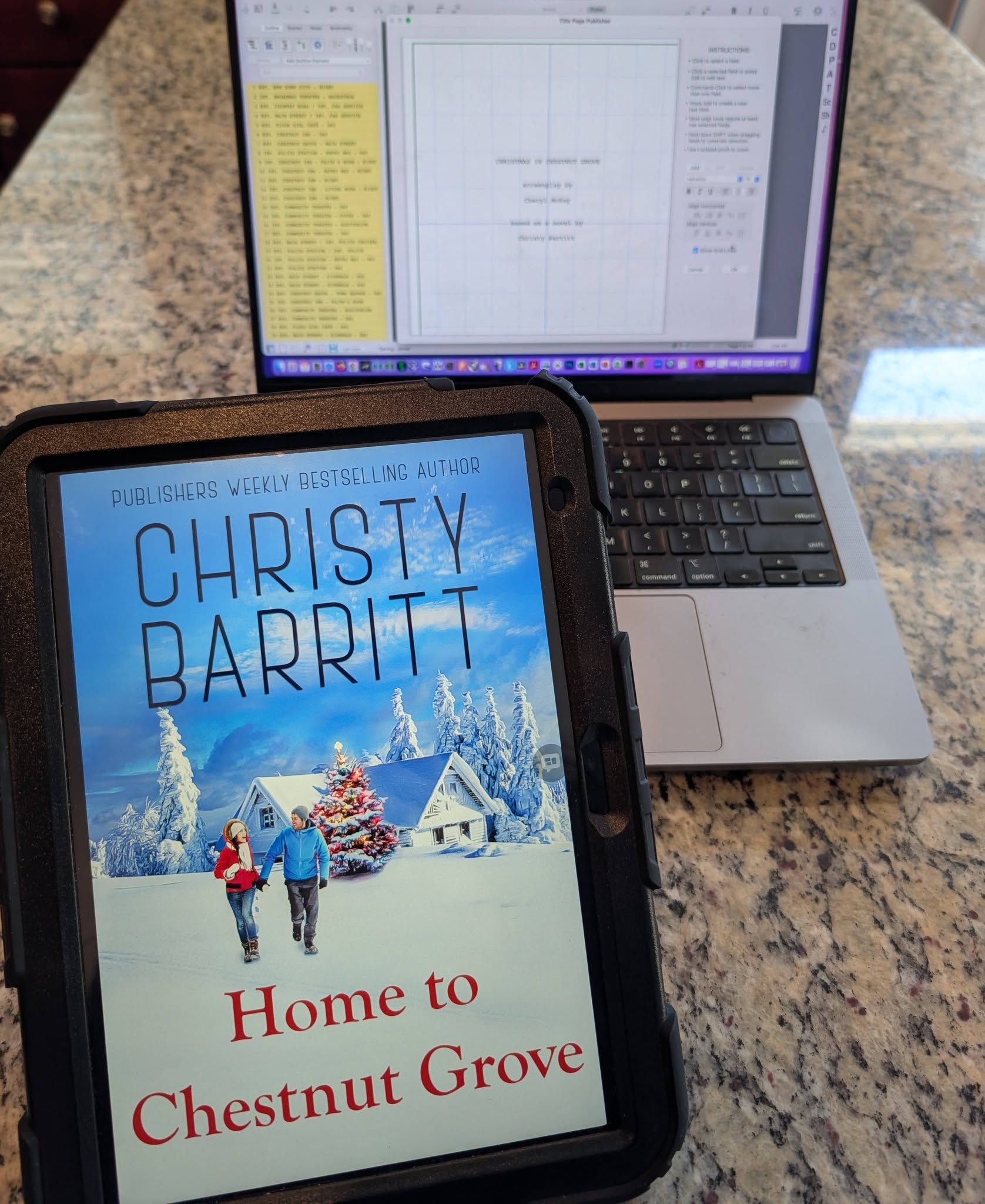
And speaking of writing scripts, I had a fantastic time this past month adapting one of my favorite author’s novels into a screenplay. It was Christy Barritt’s novel, Home to Chestnut Grove, now titled Christmas in Chestnut Grove.
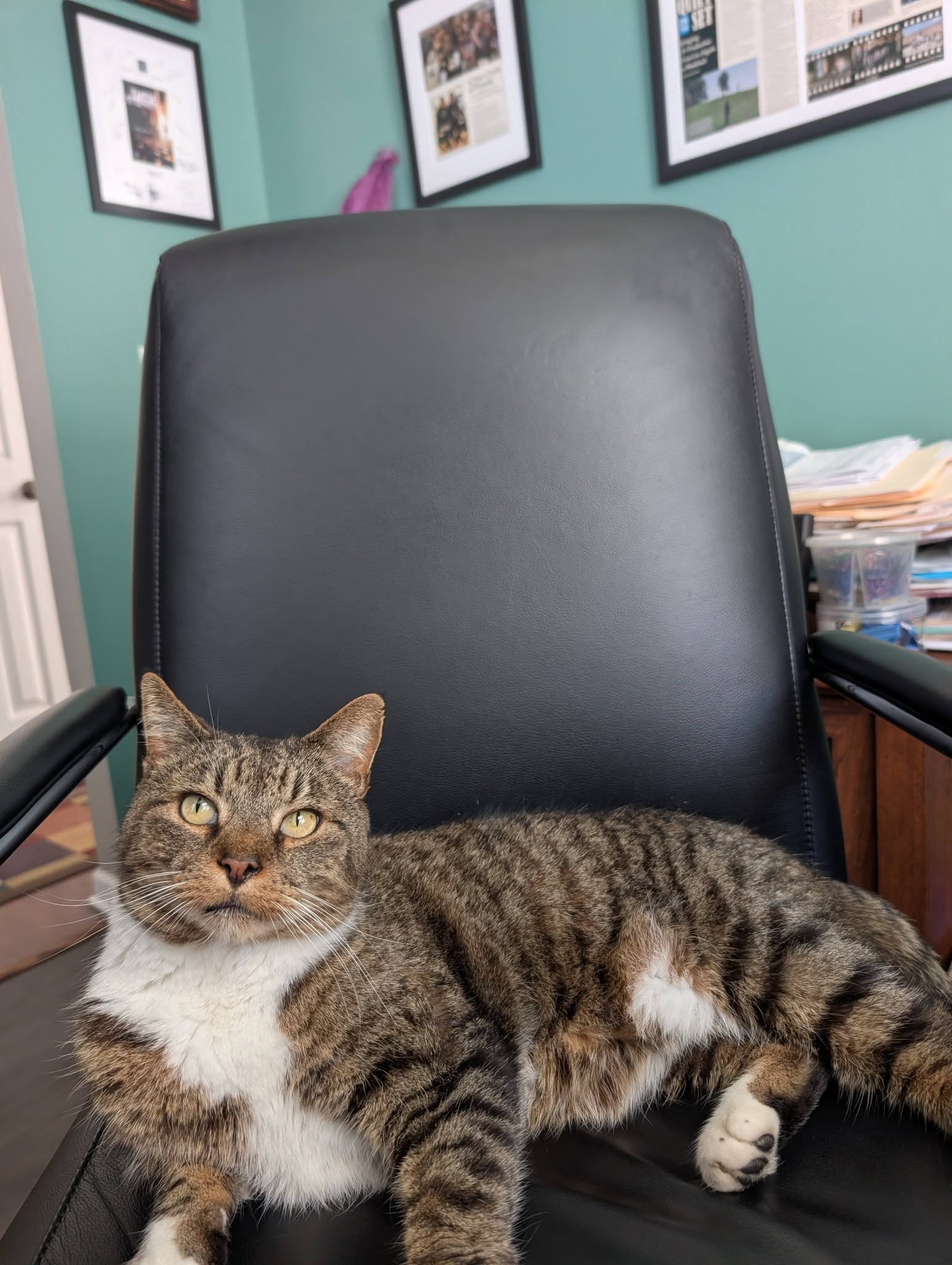
Even Socks helped–or interrupted–a lot! Depending on how you look at it.
The novel story is so charming! I also had a blast imagining quite a few of my favorite actors, many of whom I’m worked with, in the roles. Sometimes that helps my writing come to life. Their unique voices chattering away.
For those of you who are writers: Do you also do that when you draft a screenplay?
Drop me a note or a blog comment when you get a chance.
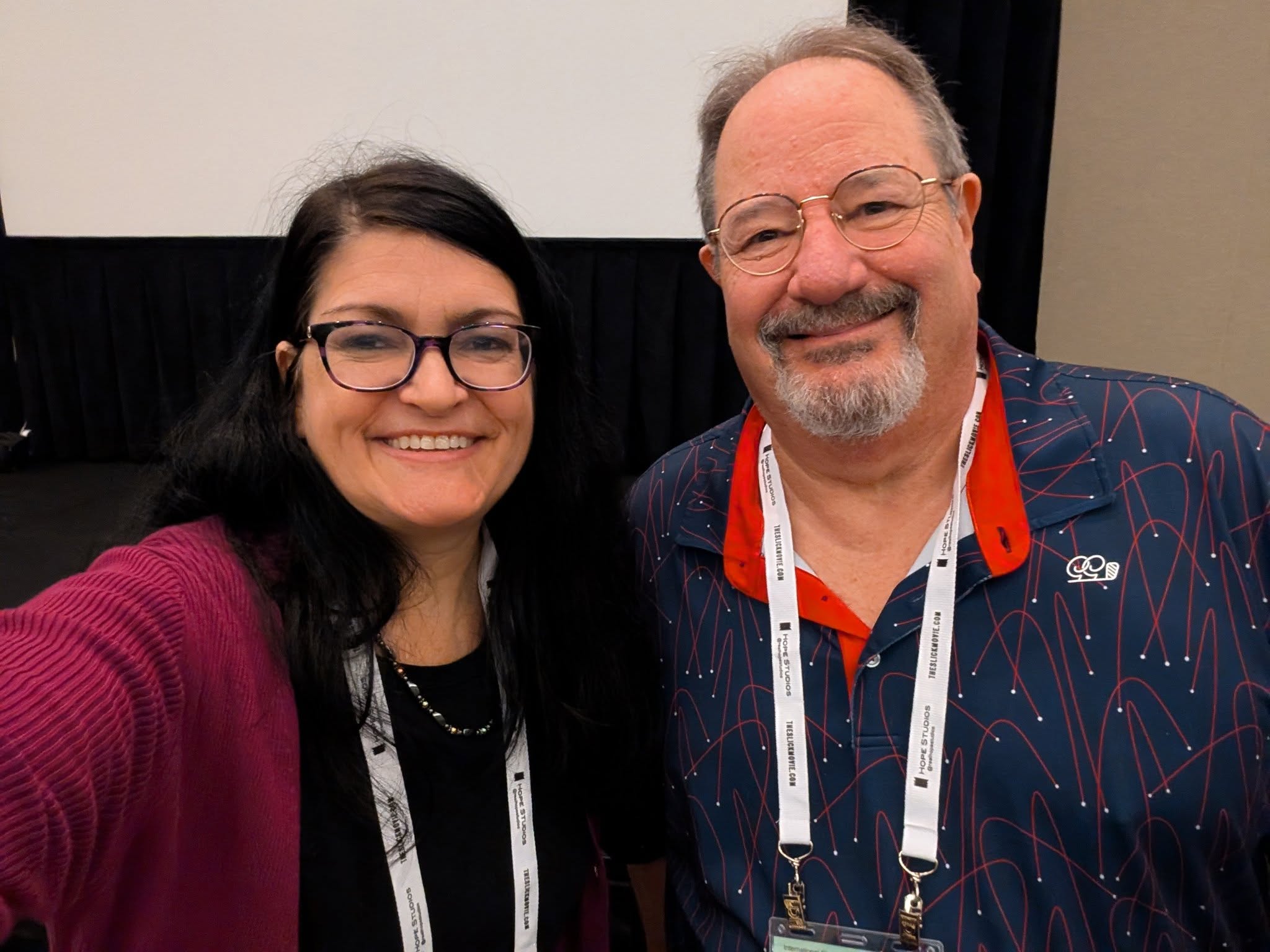
Cheryl & Bob at ICVM / Orlando Oct. 2025 (co-teaching a class on pitching scripts)
It’s been such an honor to serve with screenwriter, Bob Saenz, on a variety of screenwriting panels and speaking together at conferences. By far, the most fun was co-teaching about how to pitch scripts to producers. Bob is not only a talented writer, but a great friend. A champion of fellow writers. There is not a phone call I ever end with Bob where I’m not left super encouraged about what’s next. I hope you enjoy this conversation with a very experienced screenwriter.
What is your favorite script that has been produced and why?
Can I have a couple? Help for the Holidays will always have a special place in my heart. My first produced film, almost word-for-word what I wrote. Summer Glau in her only Hallmark film ever (she said in an interview the only reason she did it was the script, yay!). It was a huge ratings success for Hallmark. The start of a 10 film run for me with them.
I also love Christmas Yule Blog… a film I wrote for Lifetime that celebrated my Cuban roots. It’s different. Set in New Mexico, no snow, and the use of all of the things I experienced as a child with my Grandmother at Christmas to make it real. Again, everything on screen almost exactly as I wrote it. That doesn’t happen a lot to any writer. Some films more than others and some–not anything you wrote. But that’s another topic.
#3. I’m grateful for Extracurricular Activities, a script I wrote that got my writing and voice noticed, that opened every door in Hollywood. It’s the Anti-Hallmark script that got me my first job a Hallmark. Then it got made, 18 years and 8 options later, including a studio. It made a couple of 10 Best Films of 2019 lists by some pretty good critics. And it’s turned out to be a cult film now.
Truth? I really like 19 out of the 21 films I’ve got my name on as writer. No, I’m not telling you the two I dislike.
What is your approach to taking notes from producers and networks? And what do you do when you know a note is “off” or will potentially impact the story in the wrong direction, but you still have to address it?
Notes are inevitable if your script is in development or production. You’re going to get them. And as more people are involved or like the project and want their stamp on it, the notes will vary, sometime even being at odds with each other. How you react to them will be the difference if you stick to the project or are cut loose and replaced.
I happen to love notes. Most of the producers and directors I’ve worked with are good at what they do and most of the notes I get actually make the script better. I’m always grateful for good notes. I make it a point to thank people for their good notes.
Do I get notes I disagree with? Absolutely. How do I deal with those? Story logic. The worst thing any writer can do when they get what they think is a note that doesn’t make story sense, and it’s ALL about story, is to let their ego or emotions control their reaction to it. That’s writer suicide with producers. You might as well fire yourself. But if you deal with those notes by using the logic you’ve used to build your story, your knowledge of character and plot and how interrelated everything in your story is and how a particular note would disrupt the story to the point that an audience wouldn’t believe it anymore… or it would change the story they wanted, you can often persuade them to forget that note.
If they still want a note you know will not improve your story, you use your creativity to integrate it in the least harmful way possible and still satisfy the note giver. It’s a tightrope. Your complete knowledge of your story and of what your characters will or won’t do by the way you’ve defined them in your story will make these kinds of notes easier to deflect. The more experience you have, the simpler this is to navigate.
It always comes down to the Golden Rule. Them with the Gold makes the rules. Screenwriting at this level is a job and your job is to integrate notes. You get to be creative, you get to give them your point of view on each note (notice I didn’t use the word “argue”), but you still have to do it.
Writers have to get creative to make our living as writers and think outside of the box. What is your advice for film and TV screenwriters to do for work during those in-between times? What kinds of jobs can they seek that are still writing even if not for feature films and TV shows?
I can only speak from my experience. I wrote two books. One is a non-fiction book about the business of screenwriting based on my experience, That’s Not the Way It Works, and I wrote a novel that’s done pretty well. It’s not a lot of income, but it comes monthly.
I’ve also written instructional videos, corporate videos, articles for Script Magazine, for Pipeline Artists, for Blogs, and Writer Websites. This all depends on where you are on the experience list. But places like LinkedIn and others are good places to look for these kinds of opportunities. Right now, companies are out there looking for writers for Vertical Videos. It’s not very good pay, but it’s a stepping stone. You have to be proactive. Work never arrives at your door, you need to endlessly seek it.
How much plotting do you do in advance of starting a writing job? What are some of your go-to techniques? (I’ve seen your yellow legal pad comments and photos on social media. What’s that about?)
Ok. I’m going to get this out of the way. I’m a pantser. I do not outline. I do not write a treatment. I do hand write character and story notes on yellow legal pads before I start. I always know my story idea, basic characters I’ll need (I come up with others as I write), and I know the ENDING. The unchanging ending. So I have a path to put my protagonist on. Nobody’s getting lost in the weeds because I have no specific place for them to get to.
Then I spend days writing it in my head. Yep. I’ll use the legal pads to jot down cool two or three word stuff I’ll use at some point or a set-up and pay-off, but I discover a lot of those, too, as I write. I also rewrite as I write. It takes a little longer, but I end up with a first draft that looks like a third one. I don’t believe in the vomit draft because I don’t want anything I’ve written to have the word vomit attached to it.
Do I recommend this way of approaching the writing of a script to others? No.
If you ask 100 writers what they do to prepare to write a script, you’ll get 100 different answers. My advice? Try it all. Outlines, Treatments, Note Cards, Bullet Points… try it all. See what works for you. I tried them all and by page 11 was so far away from what I planned I stopped using them. That’s me. Not you. It works for me. You need to find what works for you.
What would you tell your younger, aspiring writer self, when you were just starting out, that you wish you’d known from the beginning?
You have an hour? How hard it was going to be. How much craft there is to learn to do this well. How much marketing you have to do after your script is ready to be seen. How long it takes to get your first produced film. These are things everyone starting out needs to know.
But I’m happy that I went ahead without knowing people said you need to stay in a lane, get known for writing one genre. I didn’t know that so I wrote in a ton of different genres and was successful at it. I’ve never stayed in any lane and it’s not only been creatively a blast, but opened me up to all kinds of jobs in all kinds of genres.
Right now, I’m actively working with producers on a couple of Christmas Rom/Coms, a Horror film, a Children’s Animated Series, a big Animated Musical Adventure, and a dramatic anthology series.
It’s not a lane, it’s a freeway, and I’m happy to be on it.
Wow. That is worth repeating. It’s not a lane; it’s a Freeway. So great, Bob. Any adds?
I always have to bit of advice for writers.
One: Don’t be boring. Look at every story you want to write at the oddest angles you can. Be original. Don’t follow trends, set them.
Two: Don’t give up. There are going to be dark times as you try to do this and you’ll want to give up. People will tell you to give up. If you really want this, you won’t listen to them or yourself and you’ll plow forward. Nobody who gave up ever went on to success. It can be done. If I did it, anyone can. Honest.
Thank you so much for joining us for this insightful Q&A Bob.
What are websites or links to follow you?
I’m on X and Instagram as @BobSnz
And on Facebook as Bob Saenz
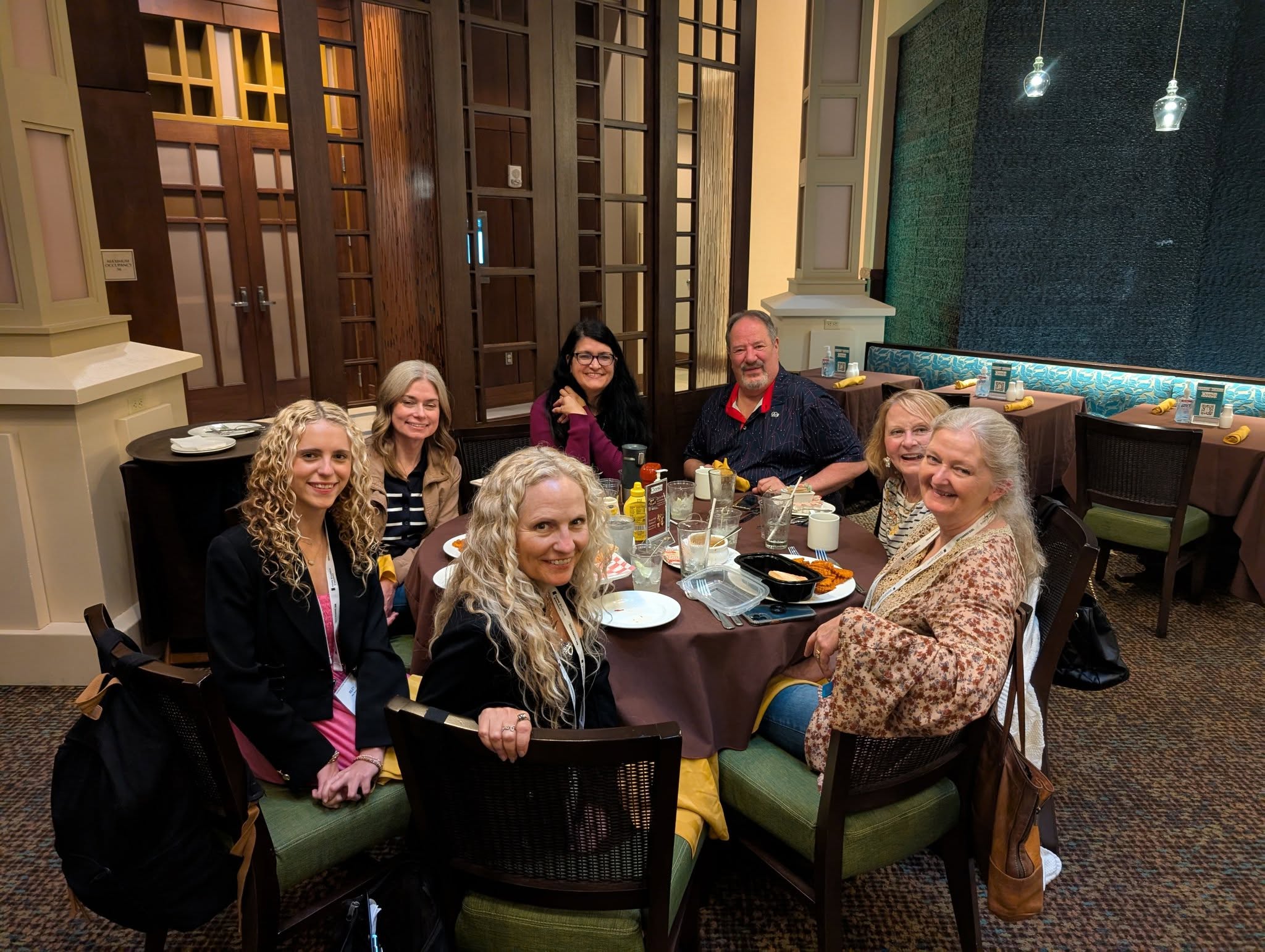
PHOTO 1: ICVM October 2025, Cheryl with Bob, his wife, Margie, writer, Heather Blanton, Actresses Denise Gossett & Riley Beeson, and writer, Rene Gutteridge.
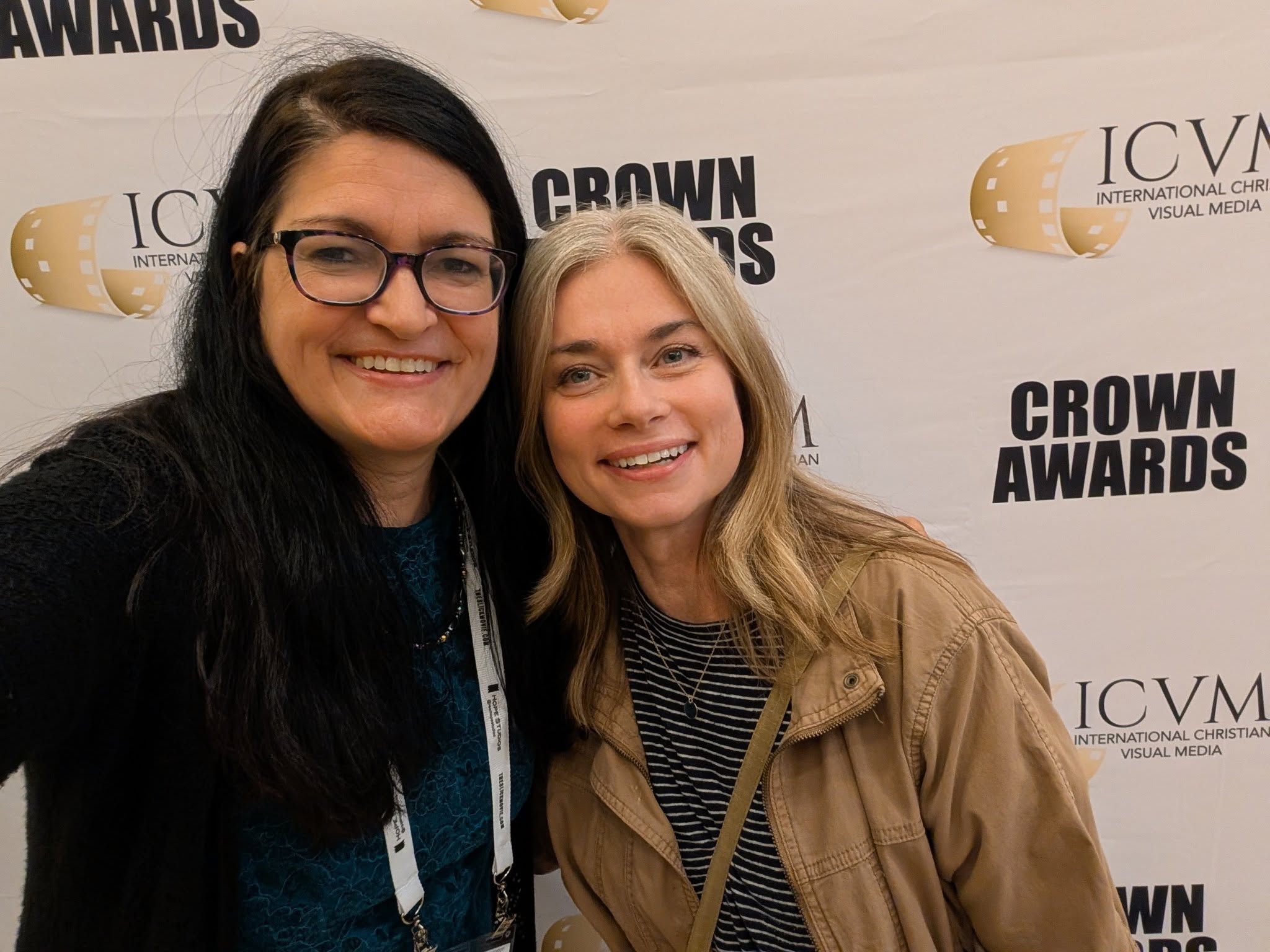
PHOTO 2: ICVM Cheryl with Rene Gutteridge
For further deep dives into the process of other professional writers pictured here, check out my other writer Q&A blogs with Heather Blanton and Rene Gutteridge.
As a screenwriter/novelist, I often stumble upon some very talented writers whose work I admire. One such author is Christy Barritt, known for faith-based cozy mysteries. If you’ve heard of actress Joey Darling, Gabby the Crime Scene Cleaner, or Lantern Beach’s Police Chief, Cassidy, you know how engrossing her characters are. (And I can’t forget Holly Anna Paladin. Or the True Crime Junkies, or the crazy things that happen in Fog Lake.) I’ve read more of Christy’s books than any other author.
One favorite of mine is Home to Chestnut Grove, a book I’d love to one day adapt into a cozy Hallmark, UP-TV, or Great American Family style Christmas movie.
I have my sister, Heather, to thank for introducing me to Christy when she thought I’d enjoy her Holly Anna Paladin series. I read all seven during one summer. And I’ve been hooked since.
I got the chance to ask Christy for a peek behind the curtain of how she manages to write so many new books every year. I hope you enjoy our conversation:
When did you first realize you wanted to be a writer and what drew you to “cozy mysteries”?
I’ve wanted to be a writer for as long as I can remember. I actually wrote several books while I was in high school. I’ve always loved reading and stories. The fact that I can create them now and make a living at it is a dream come true. I was drawn to writing mysteries because I wanted to write what I liked to read—and those books always contained a dash of history, suspense, and romance.
How many books have you published up until this point of your career?
Just this year I hit 200 books written and published. I have sold over 5 million copies of my books, which is unbelievable to me!
I love how often, when I think you’re done with a series, you announce in your newsletter you missed those characters and wrote another installment. Usually, I’ve missed them too! Out of all of them, what is your favorite series so far and who is your favorite character you created? And why?
That’s hard for me to say—kind of like choosing a favorite child. But if I had to pick I would say Gabby St. Claire from the Squeaky Clean Mystery Series. She and I have been hanging out for many, many years. In fact, the first book in that series came out nineteen years ago—which I find hard to believe. Gabby is the one who got me started with my writing career, and I suppose in some ways I can see part of myself in her. We have different backgrounds and lives, but I still feel in some ways like she’s my alter ego. I so enjoyed writing the Squeaky Clean series and diving into Gabby’s adventures. I hope to one day do another series featuring Gabby and Riley together. But I’m not quite ready for that yet.
The amount of books you write and publish a year really impresses me. You are so prolific while never compromising quality. Talk about your writing process from idea to publication:
Since I write so many books a year, I’ve really honed the process of how I write in my books. I can in general write, edit, and publish a book within four to six weeks. One of the things that allows me to write so fast is that I dictate my first draft fairly quickly. When I’m dictating, I can write anywhere between 6000 and 12,000 words per day. That means I can finish my first draft within a week or two. I plot out each section of the book as I go. Once I finish that first draft, I go through and revise it two or three times. Once I’m happy with it, I send it to my assistants and get their feedback. Then it goes to beta readers and edits and finally, proofing.
Cheryl Here–Wow. That’s amazing. Speaking is a totally different brain than writing by hand or typing. So I’m in awe your mind lets you be creative in the form of book prose on the spot like that. I can brainstorm out loud. And I do so in my car into a recorder. But I could never write a book or screenplay that way with prose, POV, interior monologue or dialogue formed into coherent conversations. I’m also a plotter the max. But you’ve inspired me to want to figure out how to train my brain to do that.
Given that you plot as you go, does that mean you do not know who the villain will turn out to be when you start a book?
I usually have a few ideas in my mind, but I’m not sure which direction I’ll go. Sometimes all of that changes and the villain is a surprise, even to me!
What advice would you offer to writers who struggle with writer’s block or procrastination?
Writer’s block and procrastination can both be difficult for sure. But the best way to get through these are by simply writing. I know that sounds probably a little too basic. But sometimes people can sit on their ideas for too long or examine them over and over. And sometimes it’s just a matter of jumping in and starting. Even if you end up writing something that may seem terrible and no good at the time, once you have the words down, you can always change them and make them better.
Sometimes, in the past, when I’ve struggled with writing my next chapter, I’ve realized that it’s because there’s a problem with the core of the story. Maybe there’s not enough tension or conflict to sustain the plot. That means I need to go back and rework my basic story premise so that it’s strong enough to carry the entire book. Once you have the premise down and all the proper elements in place, the story usually flows pretty easily.
You’ll never write a book if you only think about writing the book. And the more you write, the better you will become at it. So keep pushing forward because even if your early books aren’t wonderful, you can consider them your practice books. I probably have 12-15 books that I wrote at the beginning of my writing journey that I consider practice books. They will never see the light of day—not unless I decide to rewrite them, at least.
You had a movie made from one of your books. Tell us about that and are there more of those coming for you in the future?
Yes, I did! Hazardous Duty, the first book in the Squeaky Clean mystery series and one of the first books I ever had published was made into a movie. It released in 2022 on select cable stations. It’s now available to watch through Amazon Prime as well as a few other places. (As of this blog posting, it’s currently free for Prime Members to watch the movie.)
Most people think the movie happened overnight, but in truth it was about eight years in the making. That means between the initial interest and optioning of the book and the time it was released, there were a lot of ups and downs. There were a lot of moments where it seemed like it would happen and then it didn’t happen. There were lots of periods of time when I heard absolutely nothing at all and wondered if the project had been forgotten.
Then, just when I tried to put it out of my mind, I got an e-mail one day from the producer and she informed me that they were starting to film in two weeks. I was actually able to go out for a couple of days to watch them film and that was a super special moment for me.
The movie didn’t exactly follow the book, which made some of my hard-core readers unhappy. But overall it was a really fun experience. I have other books that are optioned, and originally there were going to be more Squeaky Clean movies. However, it has been a while since I’ve heard anything (which seems to be what happens in the movie business!) So now I’m just waiting to see if I hear anything. I would love to see more of my books as films.
Please include links to your website and social media sites:
Thanks for joining us today, Christy, and sharing your creative process. And please write more of Joey, Gabby, and Cassidy, even together like you did in your recent book, The Crime of Our Lives.
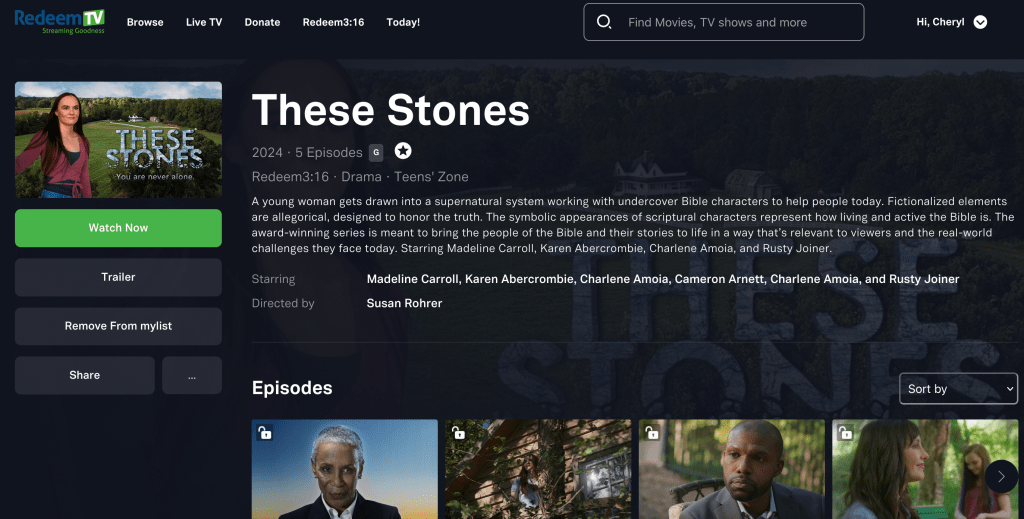
It’s been a while since I last gave an update about These Stones, and a lot has happened since its first release on UP Faith & Family last September! We will forever be grateful to UP Faith & Family for a fantastic debut into the world. It’s still available on their streamer for just a $5.99 subscription per month. They have great programming, including my personal fave, Hudson & Rex and tons of Christmas movies, and the new Sugar Creek Mysteries which happens to star 3 of our very own from These Stones. Join here.
This past Easter, These Stones also made its cable debut on UPtv, reaching an even broader audience during one of the most meaningful weeks of the year. It was our first time airing on cable television — and what a joy it was to hear from new viewers discovering the series for the very first time. Since our series is grounded in a verse at Easter time, this was a great choice by our network. We got 2 full marathon airings including Palm Sunday and the day before Easter.
Since then, the series has expanded into even more viewing platforms. If you haven’t yet seen These Stones, or you know someone who would love it, here are all the current ways to watch Season 1 (6 episodes total):
Where to Watch “These Stones”
Vision Video has been a tremendous partner to us both in streaming on Redeem TV and selling DVDs:
Amazon Thanks to Deep C Digital, we are now available for purchase/download on Amazon. (Please note: this is not included with Amazon Prime Video). It’s approx. $13 to buy the whole season. Make sure you choose the season and not an episode as it’s the same price for all 6 as it is to buy one at a time.)
New Faith Network For those outside of the US, New Faith Network is streaming our series internationally in many markets. If you are not in the U.S., check to see if they have your area. They’ve subtitled the show into a variety of foreign languages as well. Click here to see the series page, where you can also access what markets they are available in and subscribe to watch. This link goes to the EN version of the page. The pull down menu on the right shows all the regions.
Festival Recognition
These Stones has had a blessed run on the film festival circuit, where it’s now won 32 awards and earned 16 additional nominations across categories including Best Series, Best Pilot, Best Ensemble Cast, Best Director, Best Writer, Best Score, and many of our actors have been honored with Best Actor wins and noms (including Madeline Carroll, Rusty Joiner, Charlene Amoia, Karen Abercrombie, Cameron Arnett, Elizabeth Becka, and Katherine Shepler). We’re humbled and grateful for the encouragement this story continues to receive. Here’s a sample of awards we’ve won or received nominations in:
If you’re just now discovering the series, here’s a quick blurb:
Inspired by the intriguing verses in Matthew 27:50–53, These Stones allegorically imagines a modern world where the saints who rose from their graves at Christ’s resurrection never left. Set in a small town where miracles and mystery meet every day struggles, the series follows these ancient saints as they quietly help modern people navigate questions of purpose, pain, and faith.
The first season contains 6 heartfelt, family-friendly episodes designed to inspire, uplift, and spark meaningful conversations. It follows the Stuart family that has experienced a deep loss. Daughter McKenna (played by Madeline Carroll of I Can Only Imagine) has to find a way to help people while grappling with her own grief.
Thank you for being part of this journey. Whether you’ve been with us since the beginning, or you’re just now finding out about the series, I hope you’ll take a moment to watch — and share it with someone who might need a reminder that no one is ever alone in their pain.
More updates to come soon — and as always, thank you for your continued support! We hope to make future seasons and have mapped out a fantastic storyline for Season 2. But we haven’t started on it yet. My prayer is we get to continue for many years to come.
And don’t forget we also have the devotional that goes right alongside Season One. (If you click on links to amazon, I may earn a small commission at no cost to you.) :Available in Kindle or Paperback & Hardcover. If you purchase the Kindle version, you can get the audible version for a small additional fee.
You can also join Kindle Unlimited to access this book and others of mine.
P.S. Want merch? Check out our CAFE PRESS store to get hats, shirts, and other things with our show logo. (I have a zip up sweatshirt, T-shirt, and a hat.) THESE STONES on CAFE PRESS.
I am very excited to have launched a new production company, where our team’s desire is to make a positive impact through inspired stories. It’s been a long-time dream of mine to write projects that I can see through from start to finish.
Our first project will be a new streaming series, These Stones:
When her mother is killed, a wayward daughter takes over a supernatural program to help others. Though she struggles to believe in God, she finds herself matching mysterious visitors from the past to those facing challenges today.
We are starting with the first season of 6 episodes, hoping the show can run for many seasons to come. Principle Photography will be Fall 2022. To read more about our project, my incredible teammates and those involved, visit the series website:
As a writer, every movie that gets made is a dream come true. I believe stories have the power to change hearts and the world.
I had the extreme privilege of working on a feature film based on a true story about a U.S. Army Chaplain, Darren Turner. I got to work with David Evans, the co-writer and director of Indivisible. (He also did the movie The Grace Card.) I have a new love for movies about marriages.
From IMDB story synopsis: “Upon returning from serving in the U.S. Army, Chaplain Darren Turner faces a crisis that shatters his family and faith in God but through the help of former soldiers, they help him return to his faith and family.”
It’s always neat to see what you envision on the page come to life. Through the cast, set design, locations etc. Movie making takes a lot of people and teamwork. I was very impressed with Calvary Church in Memphis for the many ways they gave of themselves tirelessly in support of the production team. They also blanketed this project in prayer 24-7. It showed; God’s hand was all over this.
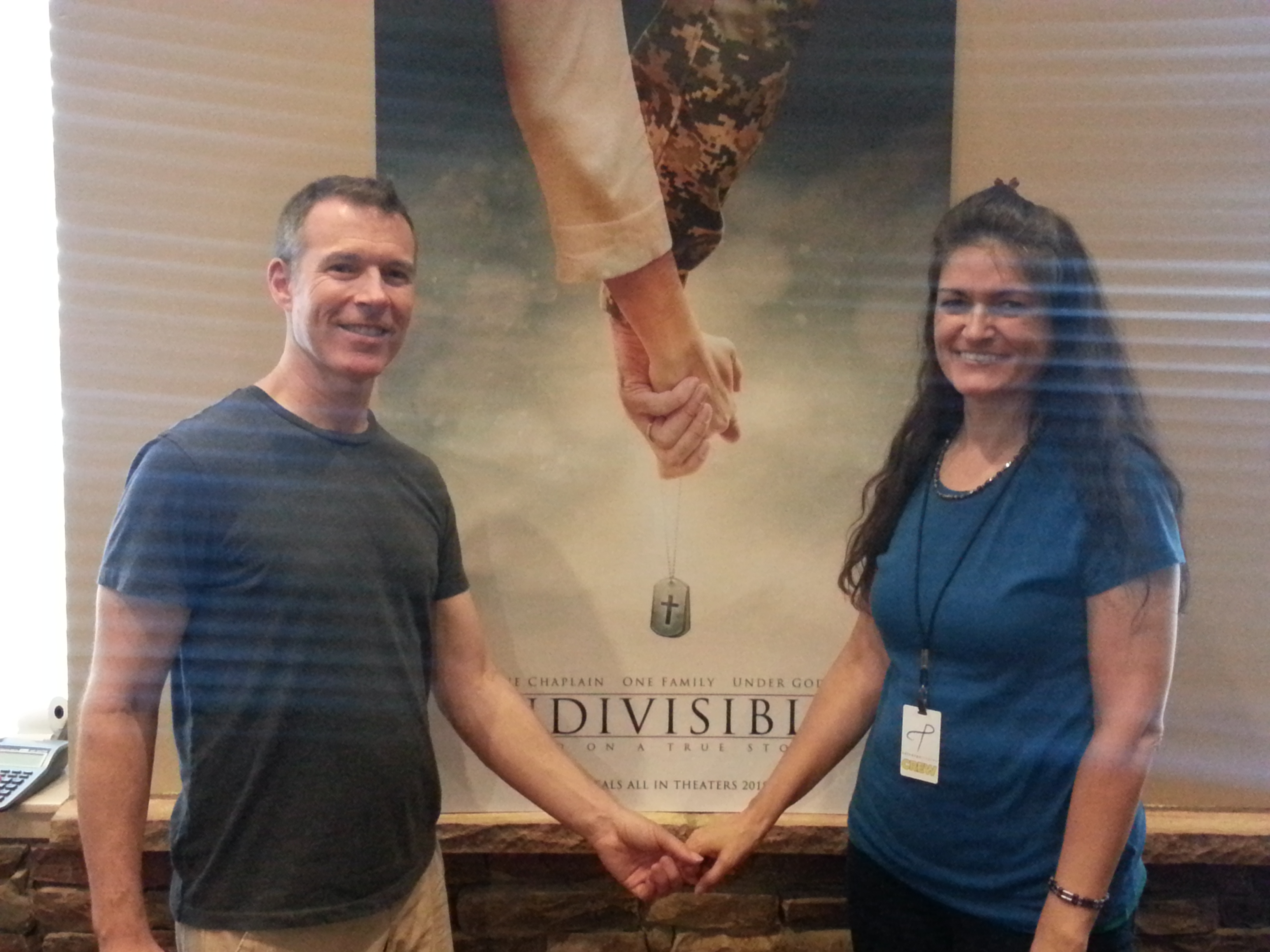
My hubby and I also got the chance to be extras in a scene. I love sharing these experiences with him:
We really enjoyed meeting some of our cast: Sarah Drew (Grey’s Anatomy) who is also one of our producers, Justin Bruening, Tia Mowry, Samara Lee, Madeline Carroll, Abigail Hummel, Leyah Brown, Lucas Boyle.
I love this screen family photo Sarah Drew shared on Twitter. They look so great together:
We also enjoyed meeting some great people on the crew. Bob Scott was our D.P. (War Room). Rebekah Cook, Gwendelynn Martindale, and our BTS crew.
I’m very thankful for Bill Reeves, the Working Title Agency team and the Provident team for inviting me to the party on this project. It was fun to see two of them on set: (Bill Reeves & Laurie Chimento.)
Lastly, we really loved meeting director / co-writer David Evans and his wife, Esther. Lovely people with great hearts. I loved knowing what he was envisioning from the page and then seeing him realize this dream.
I look forward to seeing this story released in 2018.
We had a wonderful time in Lynchburg, VA visiting the set of my next movie. I co-wrote Extraordinary, which is the true story of Ultra-Marathon legend, David Horton. It was such fun to see the talented cast and crew bringing the story to life.
Scotty Curlee (producer, director, co-writer) has such great vision and innovative ideas for visuals. My husband and I learned a lot just watching him and his team work.
David Horton is being played but Canadian actor / comedian, Leland Klassen. (We enjoyed discussing the story of my dual citizenship between US and Canada.)
David Horton’s wife, Nancy, is being played by Shari Rigby (who we loved in the film, October Baby. I’m currently reading her riveting autobiography, Beautifully Flawed.) What a wonderful lady, inside and out.
I was so happy Karen Abercrombie was cast in this film as Nina. I’ve written a project for her before, and then she played the forever-memorable role of “Miss Clara” in War Room. Cameron Arnett was cast as her husband, Mike. That was a thrill for us since we met him at our first film industry event in Atlanta.
Two very delightful actresses to spend time with on set were Lindsley Register (as Allison Horton) and Taylor Lyons (as Becky).
While I don’t have pictures of them, we also enjoyed getting to know other cast members, like Alex Bartz, Jeremy Webb, Chris Ashworth, and Jamie Ridgeway. Kirk Cameron is also in the cast but wasn’t shooting while we were in town.
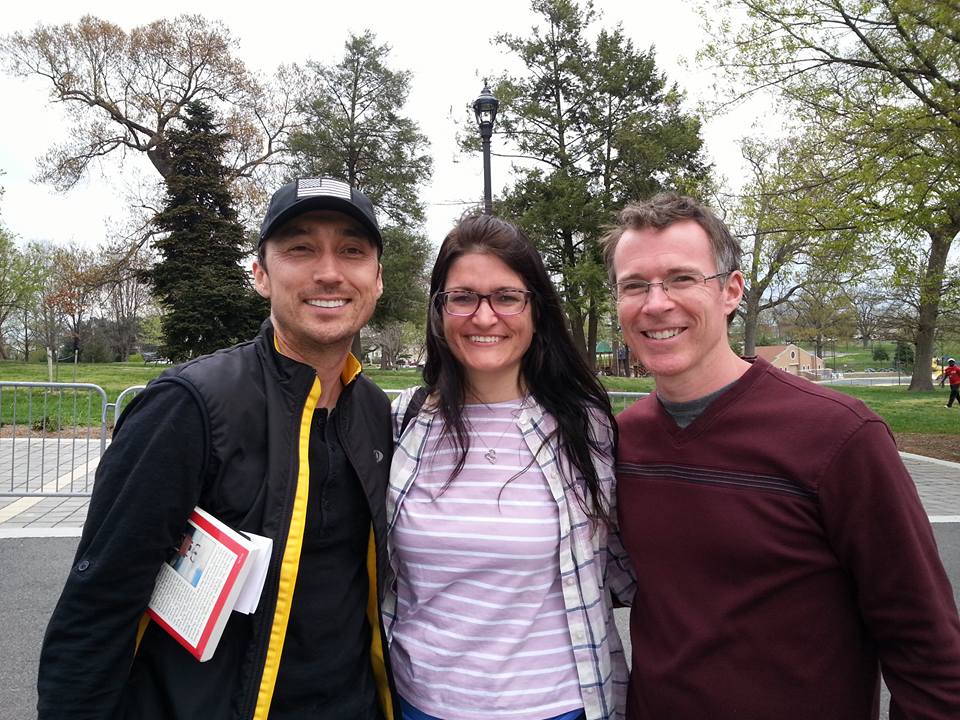
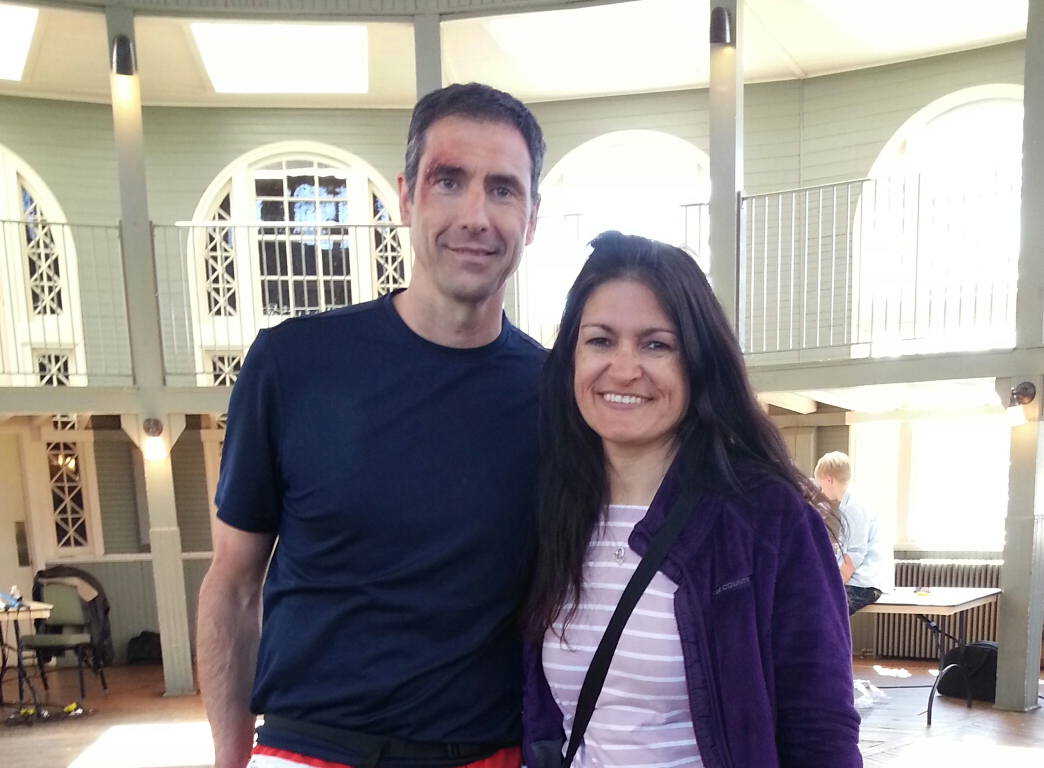
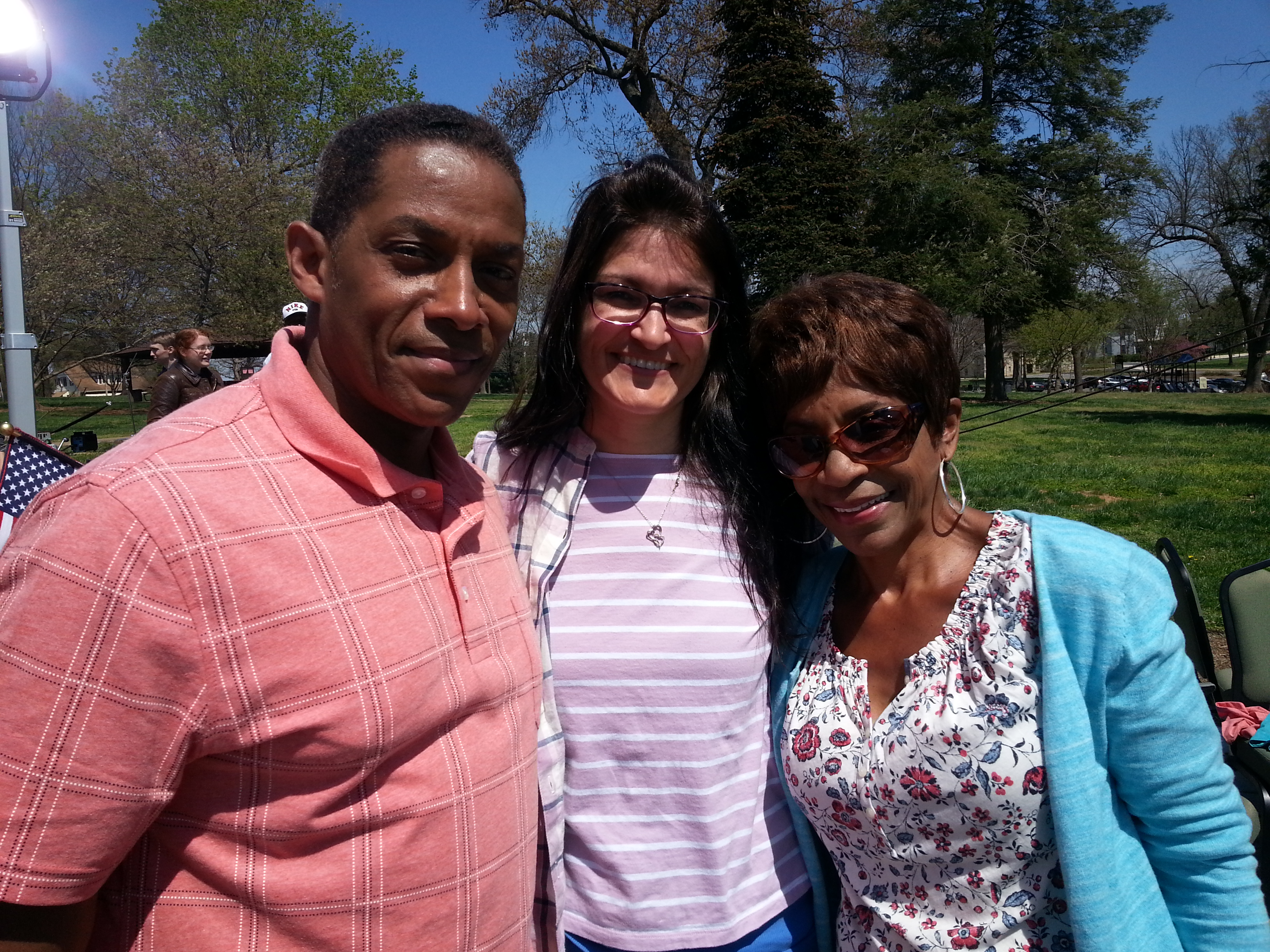
Chris and I got to be extras during a race scene. Scotty put us right by the lead cast, so we had many opportunities to get to know them during the long days of standing around and “acting” when the cameras rolled:
I can’t show too many set pictures because I don’t want to give away any story points. But here’s a few of Chris and I hanging around some locations:
And since it’s about a runner…why not get my running on?
It was a joy to meet our Line Producer, Justin Tolley. I’ve heard wonderful things about him for years about his work on sets. He and his wife, Kara, shared their son’s first birthday with us on set.
I have to say being on set reminded me why I love what I do. I love to connect with people, to use story to touch the hearts of others. Extraordinary is a story with a lot of heart to it, and it shares about the importance of prioritizing marriage and family. No goals or dreams should overshadow that. Not even my own desires for movie-making. This story will serve as a great reminder.
If you are anything like me as a writer, you don’t like waiting to see your work come to life. It’s often a long wait between movies getting filmed. I have one movie I co-wrote that is in production right now, but it’s been years since that’s happened. I’m thankful that during those years between I get the opportunity to work in novelizations. And that’s the process where my scripts get turned into novels.
I’m so thankful I was able to get to know the talented novelist, Rene Gutteridge, after she novelized my script for The Ultimate Gift. We went on to work on Never the Bride, Greetings from the Flipside, Love’s a Stage and O Little Town of Bethany. I also novelized Song of Springhill on my own, a story I’ve been working on since the late 90s. I so appreciate having an outlet to share stories, instead of waiting on productions to get funded. Releasing a story this way, I know it will get told in this one way. But naturally, the hope is it will also get considered as a film once it gains a reader base.
Have you thought of adapting your scripts into novels, so you could get in published while waiting for someone to take notice of your script?
Rene and I teach how to do this through our Udemy class, which is a mix of videos and PDF docs of our How To book.
Here’s a description of the class from the Udemy website:
Are you a screenwriter who has wondered what it would be like to write your script as a novel? Are you tired of not seeing your work produced? Releasing your story as a novel is a great way to get it out there and see if you can find an audience. This could help Hollywood take notice. Novelizing your script is also a way to share your story with the world and not wait anymore. Especially in the age when self-publishing is available to all of us. I got tired of waiting for “Hollywood” to decide my stories were worth telling and started getting into the novelizations process after my film, The Ultimate Gift, was produced. I’ve done six of these now. One novelization on my own, and five with my writing partner, Rene Gutteridge, who has been a published novelist over thirty times. She’s also a produced screenwriter. This class will walk you through what has to change from screenwriting to novel writing. Rene Gutteridge joins me for quite a few of the video lectures so you have an expert in screenwriting and an expert in novel writing teaching this class. Each section has PDF downloads. Together these include all segments of our published book Novelizations: How to Adapt Scripts Into Novels. You’ll see real live samples from many of our published works so you can get a complete understanding for how a screenplay translates into the very different writing form of a novel.
PLEASE NOTE: Udemy estimates this class has 4.5 hours of lecture content. This includes both video lectures and written PDF documents. The run time on video content is approx. 100 minutes.
Today’s author interview takes us to Los Angeles, California to speak with Cheryl McKay, author and screenwriter, as well as producer. Hello, Cheryl and thanks for taking time to share with my blog readers and me.
Cheryl McKay
Janice: How long have you been writing and how did you come to it?
CHERYL: It started around the time I was 5 years old. I wrote a play based on my Winnie the Pooh lunch box and we acted it out for neighborhood kids. I was always writing plays and short stories. I wrote about 10 plays the year I was fifteen. Well, that’s what I called them. I didn’t realize they were actually screenplays. (Too many locations to be on a stage.) I’d write them on loose paper and then recopy neatly into a notebook, and that was my idea of “rewriting.” I began to study screenwriting in…
Have you ever thought about adapting your script into a novel? Have you wondered how the process of novelization works? Rene Gutteridge and I have done a few of these together, and she’s done several with other screenwriters. We won a Carol Award / Book of the Year Award in the Women’s Fiction category of ACFW, for Never the Bride.
I also recently started adapting some of my scripts myself into novels. It’s hard work, but a very fun process. There’s definitely an art to it! It’s exactly the opposite of the process you’d go through to adapt a book into a screenplay (like I did with The Ultimate Gift). And getting your scripts out there as books just might help you get a movie made! And for novelists, you could find some good projects to work on that are about half the work of writing a novel from scratch.
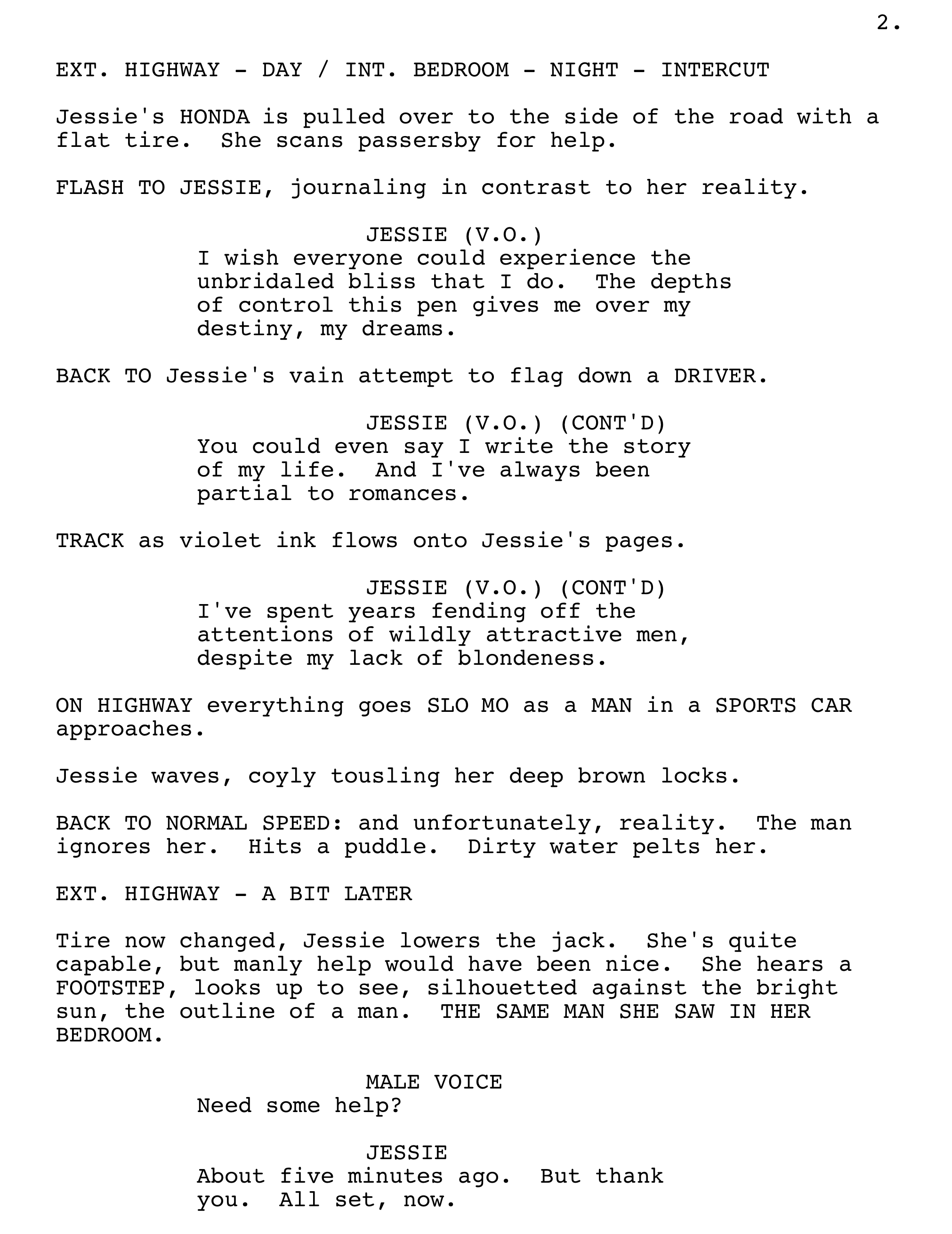
On this blog, I’d like to show you one example from my screenplay Never the Bride. To follow are the first two pages of the screenplay:
Now, before continuing to read this blog, go to your favorite book retailer and use the LOOK INSIDE or PREVIEW feature to read the first part of the novel from the opening to the point where Jessie drives off with her tire changed. (If you hop on a paperback version, you’re looking at pg. 1 through top of pg. 5.) The following link goes to Amazon’s Paperback or Google Books:
The sample included 1188 words, four printed novel pages vs. 472 words and two script pages. That’s two and a half times more words that were put into the novel to describe the same sequence.
This novel is in first-person, present tense, which gives us an active thought life from which to play. It’s like getting to write one long monologue as Jessie tells her own story.
For this blog, we’re going to focus on interior monologue (the subject of Chapter Six of our new “How To” book), one of the most useful tools exclusive to novelists that screenwriters are not allowed to use in scripts. The novel begins with the scene that starts on page two of the screenplay. It draws you into Jessie’s dilemma in a way the script simply cannot. She may be in the same predicament, but we get to spend a lot more time with Jessie, getting to know how she feels about life, her vulnerability, and her singleness. The interior monologue shares some of the information from the voice-over where Jessie is fantasizing about the life she wishes she had. Her journal habit, her hair color (and lack of blonde hair), what she sees as her ideal life. We find out she’s responsible with her job, is capable of taking care of herself, and how she feels about her boss. Even her boss’s character is set up here. All of this is revealed in the next part of the script, but in the novel this information comes out in the middle of Jessie’s crisis to reveal more about her character and life. The inner battle between her romantic optimism and her realistic cynicism shines through as well. The novel also takes a bit more time to describe the setting and the weather.
The interior monologue has a voice. It closely matches the style of Jessie’s voice from the script’s dialogue but is infused with additional humor and an openness you can’t have in a script without access to Jessie’s private thoughts.
Look at the segment of the script again where Jessie hopes the guy in the sports car will stop to help her. Then read over the novel version for that sequence. Notice the difference. Many of Jessie’s thoughts are shared during the part where she hopes the guy in the convertible will stop. We get to peek into what she’s thinking and feeling while anxiously waiting to see if he’ll help her. In reality, that scene on film would take just a few seconds, even if the director chooses to follow the slo-mo, brunette hair-blowing-in-the-wind dramatics. The novel allows us to pause and hear what flies through her mind in that moment, getting caught up in all her hopes and dreams of rescue. The script version is no less devastating to the character as she’s pelted with muddy water, yet the thoughts we get to read with Jessie in the novel are so enjoyable, so character revealing. We may even feel more for her in this moment because we got to stop and take the time to do so. Interior monologue replaces the visual of the muddy water. In book form, saying she was splattered with water does nothing because we can’t see her reaction to it, as an actress would depict it. So instead we have to go inside her head. The hope in film is that a cute and talented actress will garner some great empathy as well.
After the guy in the convertible does not stop and she decides to change her own tire, there is a sequence of her interior thought life about being single. It economically gives us an idea of what this character and story are about, what causes her pain, and she plainly states that she hates being alone. None of this exists in the screenplay, even though viewers are likely to get the same message watching an actress. Those internal thoughts voice the intention of the story of the screenplay, yet the script cannot be nearly that direct. However, notice how both the manuscript and the screenplay are moved forward with action.
The novel references the silhouette matching the man who was in her room after her nightmare. This matches the script without going into what her nightmare was about yet. It sets up that she saw this same, mysterious figure before.
This sample shows you the same sequence. It’s the same dramatic purpose. However, we traveled different writing roads to get there.
This scene is also an example of a change to the scene order (structure), as well as the challenge novelists face dealing with voice-over. This is especially true in this case where the voice-over does not match the visuals; the character is lying to herself about her reality.
We deal with all of those special challenges in translating a script into a novel in our book. This has been one sample, but we have many different samples in our new book, Novelizations: How to Adapt Scripts Into Novels.
To purchase a copy, click either on the paperback link or the kindle link below:














![Pageflex Persona [document: PRS0000035_00015]](https://purplepenworks.com/wp-content/uploads/2014/03/screenwritingfinal_frontcover.jpg)





 Cheryl McKay (Screenwriter/Book Author)